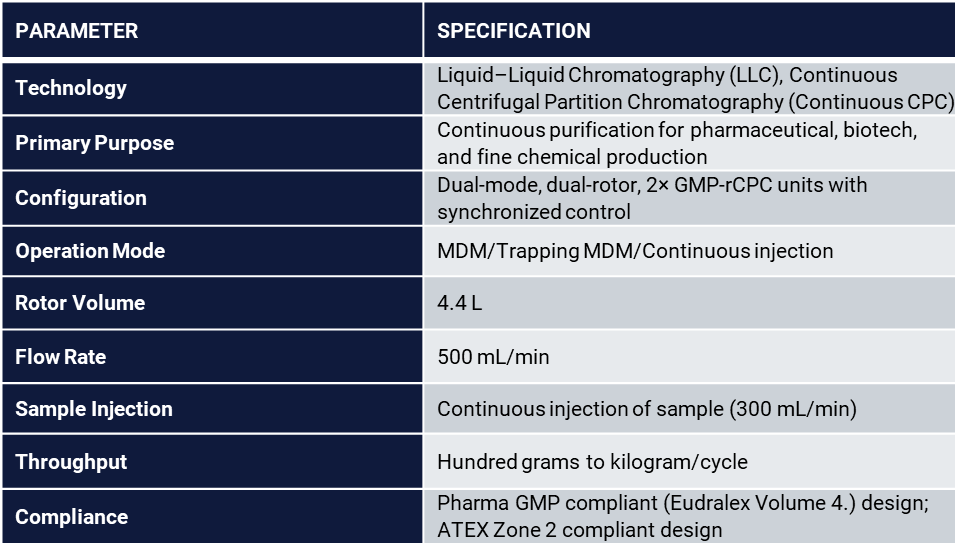
The Continuous CPC is an advanced liquid–liquid chromatography platform designed for uninterrupted, high-throughput purification. Built on two interconnected GMP-rCPC units operating in dual-mode, dual-rotor configuration (MDM-CPC), it enables continuous compound injection, seamless fraction collection, and continuous manufacturing of chemical compounds. This setup drastically boosts productivity compared to batch-mode systems, while also reducing downtime, lowering solvent and energy consumption, minimizing manual intervention, and increasing overall process efficiency. The result is a robust, scalable platform ideal for cost-effective continuous manufacturing in pharma, biotech, and chemical applications.
Unmatched Productivity in a Compact Footprint
By maintaining constant flow and alternating retention cycles, the Continuous CPC eliminates downtime between runs. This enables multiple-fold increases in throughput, with lower solvent consumption and minimal operator intervention.
Smart Solvent Handling and Modular Design
An optional on-demand solvent handling system simplifies preparation and recovery. The entire platform is adaptable to project-specific requirements, with customizable modules and robust automation for demanding environments.
Built for R&D and Industrial Use
Available in two configurations — Research & Development and Industrial Production — the platform is fully compliant with GMP, ATEX/IECEx Zone 2 standards, and supports validated cleaning procedures. The system holds CE, UKCA, and UL/CSA/NRTL certifications.

Effortless Scale-Up for Higher Production Volumes
Without batch-related constraints, Continuous CPC enables a disruption-free process, simplifying scale-up efforts even in industrial environments with high-load downstream processes.
Exceptionally High Purity
MDM-CPC delivers high-purity compounds with no overlapping peaks, ensuring precise separation, isolation, and remediation, including the removal of contaminants and byproducts.
Seamless, Nonstop Production
Continuous operation eliminates frequent start-ups and shutdowns, providing consistent sample loading and automated process control, reducing human error and ensuring a steady, uninterrupted workflow.
Smaller Footprint, Higher Efficiency
Compared to traditional chromatography systems, Continuous CPC requires less space while offering higher throughput, allowing greater production capacity without expanding facility requirements.
Advanced Purification for Complex Compounds
With its liquid-liquid nature, CPC enables efficient purification of challenging compounds by allowing customized biphasic solvent systems tailored to the target compound’s unique solubility and chemical properties.
Lower CAPEX & OPEX
New Results Published in Separation and Purification Technology
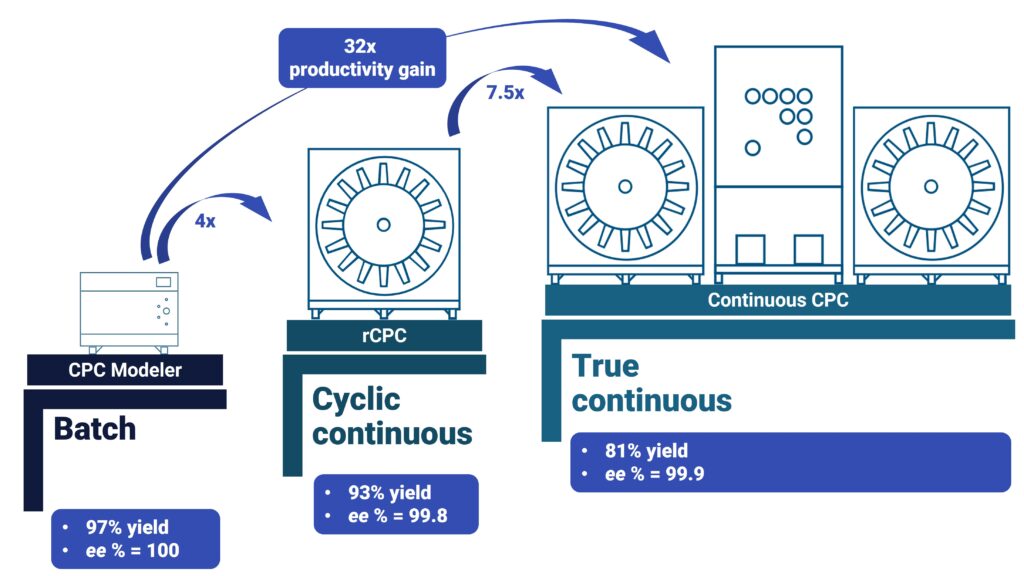
A cyclodextrin-mediated chiral CPC (centrifugal partition chromatography) process was developed for rac-voriconazole and successfully intensified from batch to cyclic continuous and continuous MDM (multiple dual mode) operation using Continuous CPC.
Recent results (A. Kiss, D. Rutterschmid, S. Muráth. Sep. Purif. Technol. 2026) demonstrate that chiral separation can be successfully transitioned from batch to continuous operation, overcoming key limitations of traditional approaches. Using centrifugal partition chromatography (CPC), continuous processing enables high-resolution enantioseparation while maintaining consistent product quality.
Moving to continuous operation significantly increases productivity and process efficiency, making chiral purification more viable at industrial scale. In a representative case, continuous CPC delivered up to 99.9% enantiomeric purity alongside an approximately 25-fold increase in productivity compared to classical resolution methods.
Importantly, these gains are achieved without compromising robustness, highlighting the suitability of continuous CPC for demanding separations. The approach also simplifies processing by eliminating unnecessary steps, supporting a more streamlined and scalable workflow.
While selector systems such as cyclodextrins can play a role in enabling enantioselectivity, the key advancement lies in the ability to operate chiral separations in a truly continuous and productivity-driven mode.
Together, continuous CPC provides a practical and scalable solution for industrial chiral purification, combining high performance with significantly improved throughput.
In the field of continuous bio-manufacturing, Centrifugal Partition Chromatography (CPC) is a versatile and highly efficient separation method. Its ability to operate continuously enhances efficiency, scalability, and cost-effectiveness, supporting high-throughput bioproduction processes while maintaining product purity and consistency. It provides high-resolution separation, exceptional productivity, and superior purity for binary mixtures while also offering a unique solution for the separation of chiral compounds, lipid nanoparticles, oligonucleotides, and proteins. Continuous CPC is particularly well-suited due to its versatile liquid-liquid nature, making it an excellent choice for flow chemistry applications.
Oligonucleotide isolation
For industrial-scale production of oligonucleotides crucial in vaccine development and pharmacology, CPC can do it in a single purification step.
Purification of isomers
CPC can purify chiral compounds, epimers and diastereomeres (e.g. remdesivir). Purification can easily be scaled up to industrial-scale compared tot raditional chromatographic solutions.
Lipid nanoparticle purification
Lipid nanoparticles (LNPs) are crucial components in mRNA vaccine formulation in pharmaceutical drug delivery research, consisting of key lipid components. CPC can not only ensures the stability of the target lipid but also outperforms traditional chromatography techniques in terms of purity and yield.
Alkaloid remediation
Flow chemistry
Flow chemistry, also referred to as continuous flow, involves conducting chemical reactions within a continuous flow stream. CPC can be integrated into a downstream purification process needed for a flow chemistry operation, and the system can benefit from the advantages of both constituents.
CPC is a liquid-liquid preparative chromatographic technique, in which separation occurs between two immiscible liquid solvent systems: acting as both the stationary and mobile phases. The liquid stationary phase is immobilized by a strong centrifugal force inside cells attached to a rotor, and the mobile phase is then pumped through the stationary phase in the form of tiny droplets. Separation of the injected sample is based on the sample component’s varying partition coefficients between the mobile and stationary phases. CPC has several advantages like low operational expenses, easy scalability, elimination of sample loss and irreversible adsorption, operation without silica gel or any solid stationary phase, and the possibility to separate a wide array of compounds.
RotaChrom Technologies develops and manufactures industrial-scale centrifugal partition chromatography (CPC) technology platforms. Founded in 2014, RotaChrom distributes its CPC devices around the world. With the help of their industry-leading chemists and engineers, their instruments revolutionized purification by providing cost-effective industrial-scale chromatography solutions to customers in various industries, including pharmaceutical, biotechnology, chemistry, nutraceutical, and botanical extracts.
Contact RotaChrom