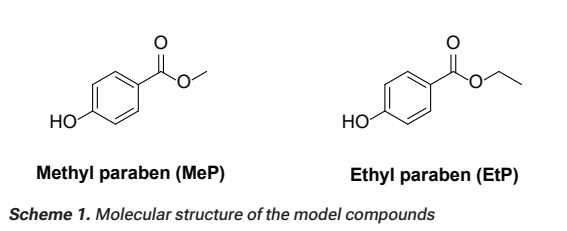
To validate CPC performance, this study employed parabens, esters of p-hydroxybenzoic acid (PHBA), as model analytes. Methyl paraben (MeP) and ethyl paraben (EtP) (Scheme 1.) were selected due to their excellent chemical stability, availability, and sharp, symmetrical chromatographic peaks. Their predictable retention behavior and favorable partition coefficients make them ideal candidates for evaluating system suitability and hydrodynamic stability in liquid–liquid chromatography.
Key chromatographic parameters such as stationary-phase retention (Sf), resolution (Rs), and theoretical plate number (N) were monitored to assess performance. By varying centrifugal field strength (90 g, 150 g, and 485 g), injected sample load, and instrument scale (Benchtop CPC vs. pilot-scale rCPC), the robustness and scalability of the technique were thoroughly examined. All experiments were performed in descending mode. Even under suboptimal conditions, CPC maintained stable retention times, peak symmetry, and near-baseline resolution, while higher g-force enhanced mass transfer efficiency and separation quality.
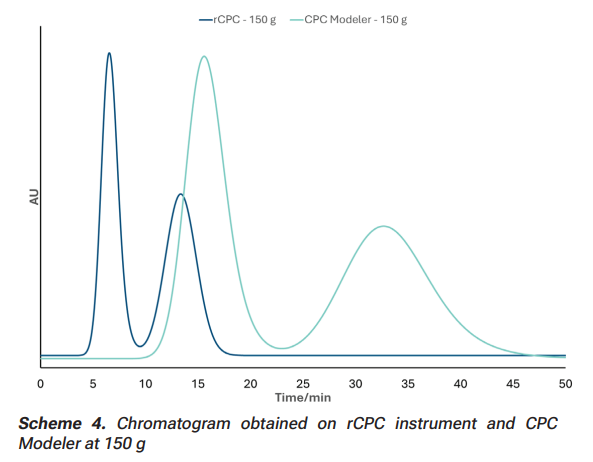
CPC maintained sharp, baseline separations of methyl and ethyl parabens across all tested conditions, proving its stability, reproducibility, and scalability in real-world purification scenarios. (Scheme 4.). Both benchtop and pilot-scale instruments demonstrated reproducible, predictable, and scalable separations, establishing CPC as a robust and reliable chromatographic platform suitable for both research and industrial applications.