

Can the challenges of lipid purification be overcome for next-generation therapeutics?
Lipid nanoparticles (LNPs) are at the forefront of modern drug delivery, playing a key role in mRNA vaccines and gene therapy products. Their formulations are built from four critical lipid components: a PEG-conjugated lipid that enhances particle stability, an ionizable cationic lipid that enables cellular uptake and endosomal escape, a structural lipid that stabilizes the bilayer, and cholesterol, which modulates membrane fluidity and integrity.
During synthetic production, these lipids often contain structurally similar and chemically labile impurities, including unreacted starting materials, over-alkylated derivatives, or degradation products. Such impurities are especially challenging to remove with conventional solid-phase chromatography, which can cause sample loss or degradation — particularly for ionizable and PEGylated lipids. Effective purification is therefore essential to ensure the stability, safety, and performance of LNP-based therapeutics.
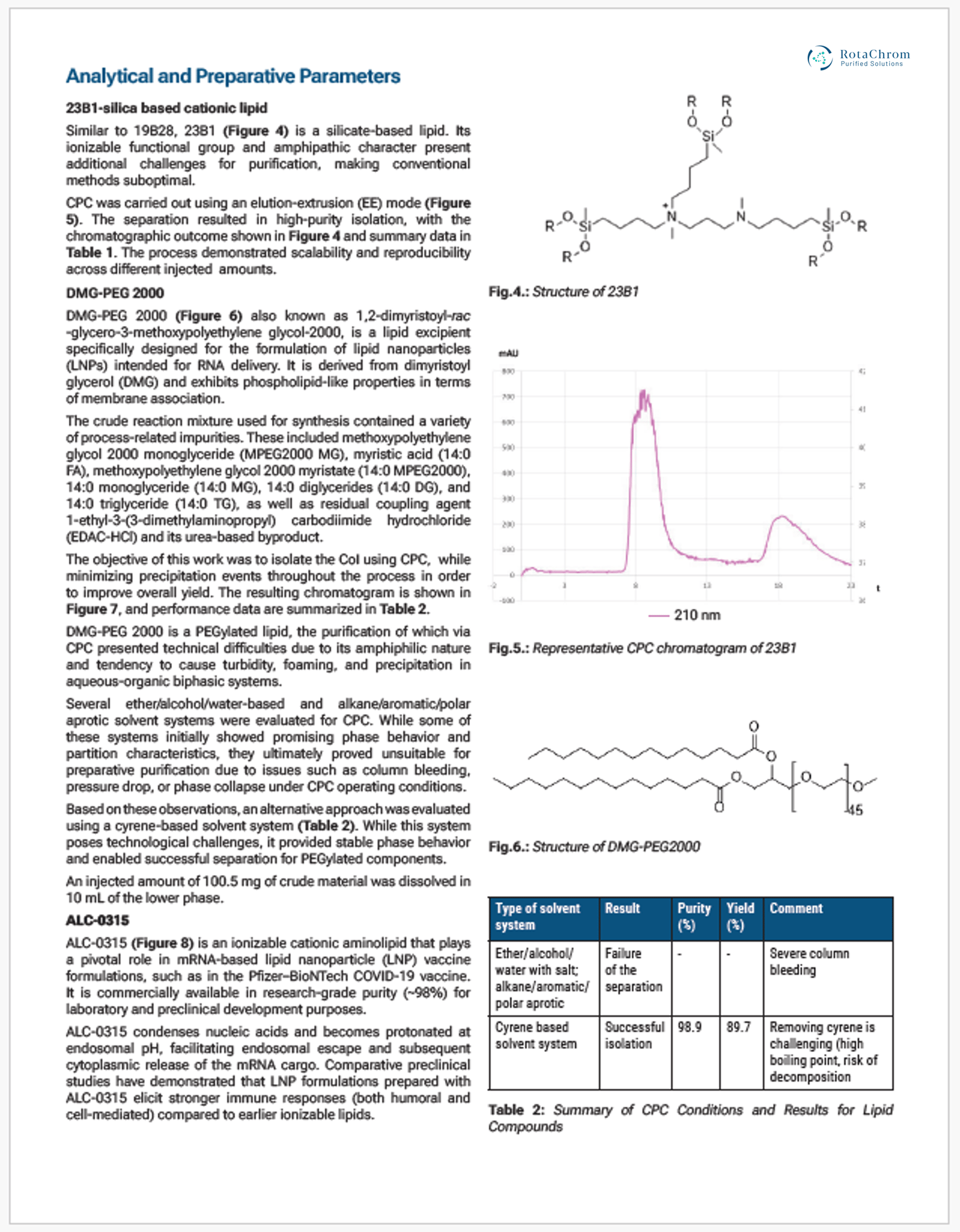
We have prepared a detailed application note that you can download, presenting real-world case studies on how Centrifugal Partition Chromatography (CPC) addresses these challenges. By eliminating the need for a solid stationary phase and using optimized biphasic solvent systems with advanced elution modes, CPC enables the gentle yet efficient purification of key LNP components — including DMG-PEG 2000, ALC-0315, 19B28, and 23B1. This approach improves yield, minimizes degradation, and supports robust, scalable lipid manufacturing for therapeutic applications.
Benefits of CPC
Gentle purification for chemically labile lipids
Ionizable, PEGylated, and amphipathic lipids used in LNP formulations are often unstable under conventional solid-phase chromatography. CPC operates without a solid stationary phase, eliminating irreversible adsorption and significantly reducing the risk of degradation for sensitive lipid molecules.
High selectivity for structurally similar impurities
Synthetic lipid production frequently generates closely related by-products with similar polarity and partition behavior. CPC leverages tunable biphasic solvent systems and partition-based separation to resolve these challenging impurities with high purity, even when conventional methods fail.
Scalable performance from laboratory to production
CPC enables reproducible purification from gram-scale laboratory development to preparative and industrial-scale manufacturing. The technology supports high sample loading, predictable scale-up, and robust operation across different lipid classes critical for LNP formulations.
Proven results for key LNP lipid components
This application note demonstrates successful CPC purification of essential LNP lipids, including DMG-PEG 2000, ALC-0315, 19B28, and 23B1, achieving high purity and yield while improving overall process robustness for therapeutic nanoparticle manufacturing.
Download the free brochure
What do you find in this application note?
-
How CPC enables efficient purification of different lipid classes
-
Ways to minimize degradation while improving process robustness
-
Case studies demonstrating the purification of key LNP components: DMG-PEG 2000, ALC-0315, 19B28, and 23B1
-
Gain access to practical laboratory results and chromatograms
-
Compare CPC with traditional purification techniques
-
Learn about scalable purification strategies for industrial lipid manufacturing
-
Get actionable insights for researchers and development labs

Book a meeting
About RotaChrom
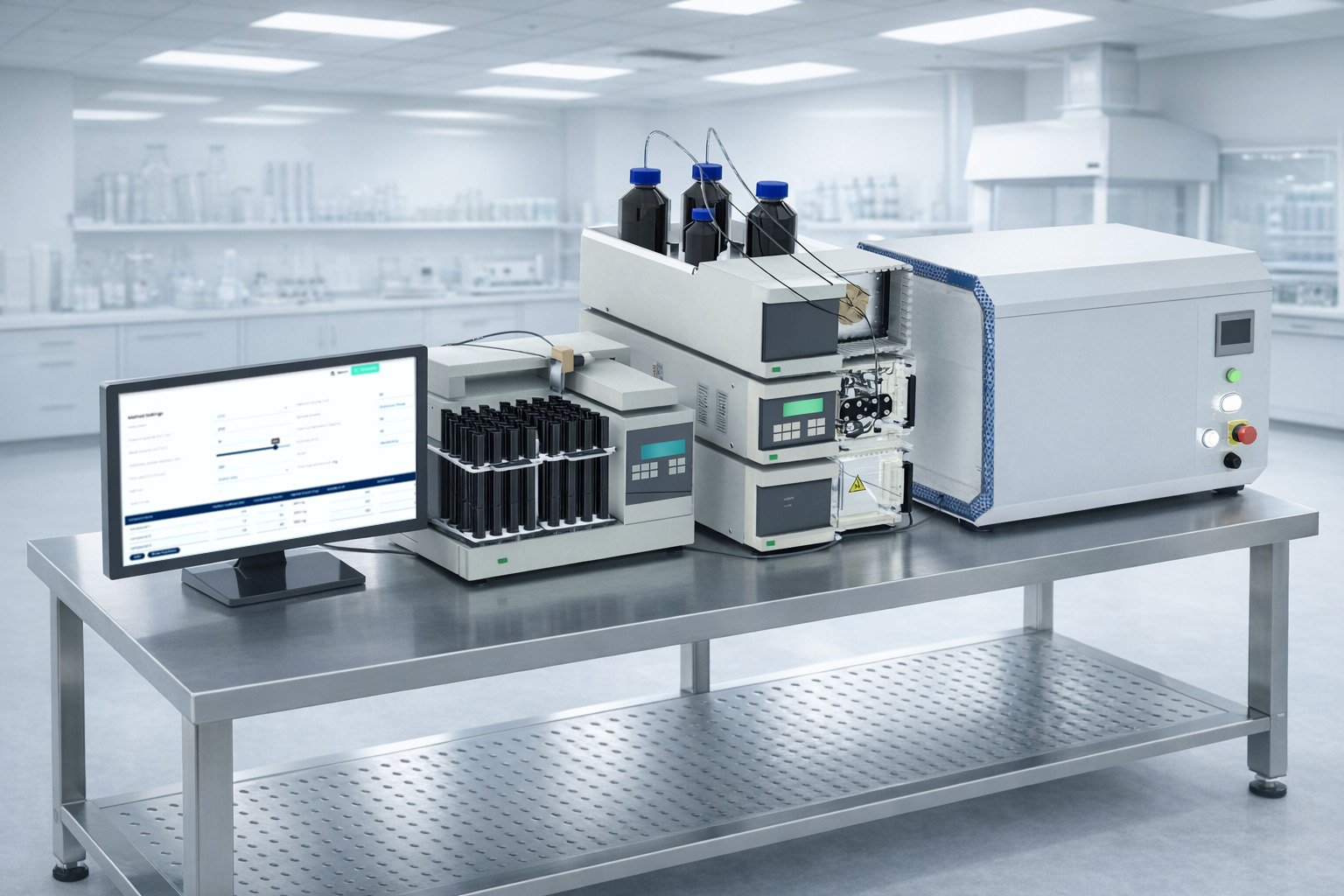
RotaChrom Technologies develops and manufactures industrial-scale centrifugal partition chromatography (CPC) technology platforms. Founded in 2014, RotaChrom distributes its CPC devices around the world. With the help of their industry-leading chemists and engineers, their instruments revolutionized purification by providing cost-effective industrial-scale chromatography solutions to customers in various industries, including pharmaceutical, biotechnology, chemistry, nutraceutical, and botanical extracts.